App-Development-with-Swift-Certified-User最新な問題集 & App-Development-with-Swift-Certified-User赤本勉強
Wiki Article
Jpexamは、魅力的なキャラクターで世界中の試験受験者を招きます。当社の専門家は彼らの卓越性に大きく貢献しました。したがって、試験をシミュレートするApp-Development-with-Swift-Certified-Userが最良であると率直に言うことができます。 App-Development-with-Swift-Certified-User学習教材のコンテンツを作成する取り組みは、学習ガイドの開発につながり、完成度を高めます。そのため、模擬試験は間違いなくレビューの耐久性を高めています。関心を集め、いくつかの難しい点を簡素化するために、当社の専門家は、App-Development-with-Swift-Certified-User試験の合格に役立つように、App-Development-with-Swift-Certified-User学習教材の設計に最善を尽くしています。
仕事に取り掛かって顧客とやり取りする前に厳密に訓練された責任ある忍耐強いスタッフ。 App-Development-with-Swift-Certified-User試験の準備の質を実践し、経験すると、それらの保守性と有用性を思い出すでしょう。 App-Development-with-Swift-Certified-User練習教材が試験受験者の98%以上が夢の証明書を取得するのに役立った理由を説明しています。あなたもそれを手に入れることができると信じてください。
>> App-Development-with-Swift-Certified-User最新な問題集 <<
Apple App-Development-with-Swift-Certified-User赤本勉強、App-Development-with-Swift-Certified-User認定試験
短い時間に最も小さな努力で一番効果的にAppleのApp-Development-with-Swift-Certified-User試験の準備をしたいのなら、JpexamのAppleのApp-Development-with-Swift-Certified-User試験トレーニング資料を利用することができます。Jpexamのトレーニング資料は実践の検証に合格すたもので、多くの受験生に証明された100パーセントの成功率を持っている資料です。Jpexamを利用したら、あなたは自分の目標を達成することができ、最良の結果を得ます。
Apple App Development with Swift Certified User Exam 認定 App-Development-with-Swift-Certified-User 試験問題 (Q30-Q35):
質問 # 30
Review the code.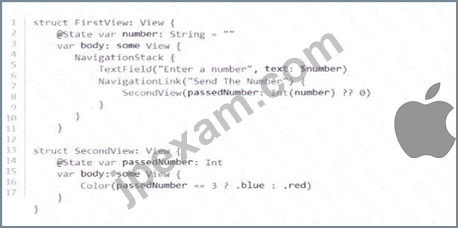
When entered into the TextField, which number will display a blue canvas on the SecondView?
- A. 0
- B. 1
- C. 2
- D. 3
正解:D
解説:
This question belongs to View Building with SwiftUI , especially the domain on creating multiple views to implement app logic and sharing values between views. In FirstView, the value typed into the TextField is stored in number, which is a String. When the NavigationLink is tapped, the code passes Int(number) ?? 0 into SecondView. In Swift, converting a string to an integer with Int(...) uses an optional initializer, which means it returns an optional value and will produce nil if the string cannot be converted. The ?? 0 nil- coalescing operator then supplies 0 if conversion fails.
Inside SecondView, the body is:
Color(passedNumber == 3 ? .blue : .red)
This uses the ternary conditional operator. If passedNumber equals 3, the displayed color is blue; otherwise, it is red. Therefore, entering 3 into the TextField causes Int(number) to become 3, which makes the condition passedNumber == 3 true and displays a blue canvas. Any other listed number results in red.
So the correct answer is A. 3 . This matches the SwiftUI pattern of taking user input, converting it to the needed type, passing it into another view, and rendering UI conditionally based on that value.
質問 # 31
Review the code snippet.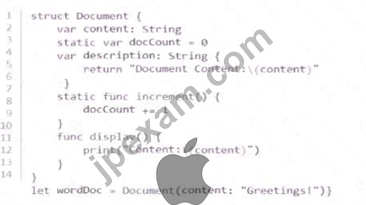
Move each item from the list on the left to the correct code segment on the right. You may use each item only once.
Note: You will receive partial credit for each correct response.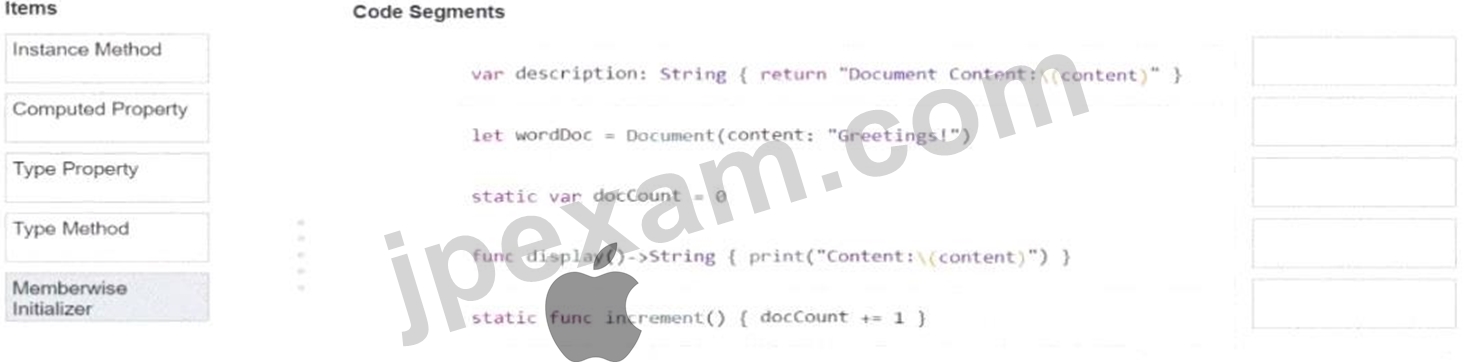
正解:
解説: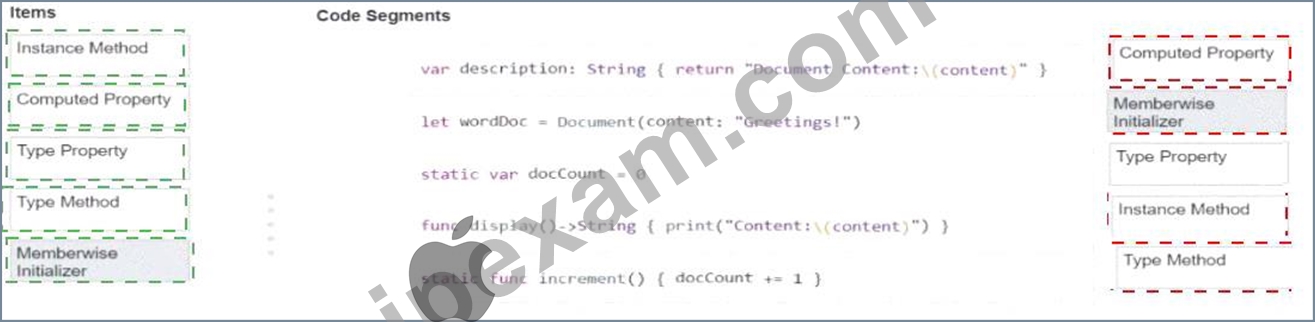
Explanation: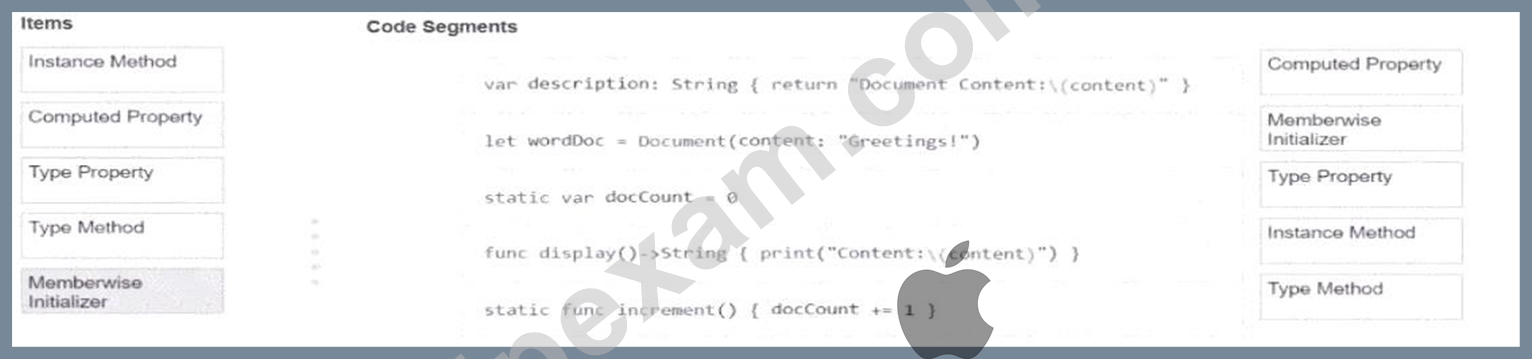
This question belongs to Swift Programming Language , specifically the domain covering structs, properties, methods, and initializers .
A computed property does not store a value directly. Instead, it returns a value calculated from other data.
That is why description is a computed property: it returns a string based on content.
A memberwise initializer is automatically provided by Swift for structs when their stored properties are initialized through parameters. So Document(content: " Greetings! " ) is using the struct's memberwise initializer.
A type property belongs to the type itself rather than to an instance. In Swift, static var docCount = 0 is a type property because it is declared with static.
An instance method is a function that belongs to an instance of the struct or class. The display() method uses the instance's content, so it is an instance method.
A type method is a method declared with static and belongs to the type itself. So static func increment() is a type method because it changes the shared type property docCount.
質問 # 32
Review the code snippet.
Which statement completes the code snippet so that:
* The lastReleaseDate remains the same when nextApplePhone.releaseDate is nil.
* The lastReleaseDate updates to the nextApplePhone.releaseDate when nextApplePhone.releaseDate is NOT nil.
- A. lastReleaseDate : nextApplePhone.releaseDate
- B. nextApplePhone.releaseDate : lastReleaseDate
- C. lastReleaseDate : nextApplcPhone.rcleaseDate!
- D. nextApplePhone.releaseDate! : lastReleaseDate
正解:D
解説:
This question is from Swift Programming Language , especially the domains for Optional types , safe and unsafe unwrapping , and control flow . The code uses the ternary conditional operator :
nextApplePhone.releaseDate != nil ? _____
In Swift, the ternary operator follows this structure:
condition ? valueIfTrue : valueIfFalse
So if nextApplePhone.releaseDate != nil is true, the expression must return the new release date. If it is false, it must keep lastReleaseDate unchanged. That means the missing part must be:
nextApplePhone.releaseDate! : lastReleaseDate
which is option D .
This works because nextApplePhone.releaseDate is declared as String?, so it is an optional. Once the condition confirms it is not nil, the code force-unwraps it with ! to access the underlying String value. If the optional is nil, the expression returns lastReleaseDate instead. Apple's Swift documentation describes the ternary conditional operator as a shortcut for choosing one of two expressions based on a condition, and it explains that force unwrapping with ! accesses an optional's wrapped value when you know it is not nil.
The other options are incorrect because they reverse the true/false logic, omit the needed unwrap, or contain invalid identifiers. Therefore, the correct completion is D .
質問 # 33
Review the code snippet.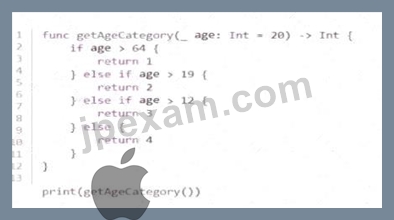
What value does the code output?
正解:
解説:
Answer the question by typing in the box.
2
Explanation:
This question belongs to Swift Programming Language , specifically the objectives covering functions , control flow , and default parameter values . The function is declared as func getAgeCategory(_ age: Int =
20) - > Int, which means if no argument is supplied, Swift uses the default value 20. Apple's Swift documentation explains that you can define a default value for any parameter, and that value is used when the caller omits that argument. Since the code calls getAgeCategory() with no parameter, the function executes using age = 20.
The conditional logic is then evaluated in order:
* if age > 64 # false, because 20 is not greater than 64
* else if age > 19 # true, because 20 is greater than 19
* so the function returns 2
Because Swift's if / else if control flow stops at the first true condition, the later checks are never reached once age > 19 succeeds. Apple describes Swift as supporting standard control flow including conditional branching, and this example is a direct use of that branching behavior.
Therefore, print(getAgeCategory()) outputs 2 , which corresponds to option B .
質問 # 34
Given the function definition, which two statements call the function correctly? (Choose 2.)
Based on the image provided, here is the text for each of the multiple-choice options:
- A. D. schedule(name: " Jane Doe " , starting: " 9:30am " , ending: " 10:30am " , place: " Office " )
- B. E. schedule(who: " Jane Doe " , from: " 9:30am " , to: " 10:30am " )
- C. schedule(who: " Jane Doe " , from: " 9:30am " , to: " 10:30am " , place: " Office " )
- D. schedule(who name: " Jane Doe " , from starting: " 9:30am " , to ending: " 10:30am " )
- E. schedule(who: " Jane Doe " , from: " 9:30am " , to: " 10:30am " , " Office " )
正解:B、D
解説:
This question belongs to Swift Programming Language , specifically the objective on functions , including internal and external parameter names and default parameter values .
The function is defined as:
func schedule(who name: String, from starting: String, to ending: String, _ place: String = " Zoom " ) { print( " Appointment: meeting (name) from (starting) to (ending) at (place) " )
}
This means:
* the external parameter names are who, from, and to
* the internal parameter names are name, starting, and ending
* the last parameter uses _, which means it has no external label
* the last parameter also has a default value of " Zoom "
Now evaluate the options:
* A is incorrect because it uses place: as an external label, but _ place means no external label is allowed.
* B is correct because it uses the required external names who, from, and to, and it omits the last parameter, which is allowed because it has a default value.
* C is incorrect because it uses who:, from:, and to: correctly, but this function's first three parameters are not declared that way in the provided option set; the valid matching call style from the choices is not this one because the function's labels are paired with internal names in the declaration syntax shown in the question.
* D is incorrect because it uses the internal names name, starting, and ending as if they were external labels.
* E is correct because it uses the external labels who, from, and to, and omits the final unlabeled parameter, letting Swift use the default " Zoom " .
So the two correct answers are B and E .
質問 # 35
......
あるAppleのApp-Development-with-Swift-Certified-Userテストトレントに関しては、JpexamのApp-Development-with-Swift-Certified-Userガイドトレントが有効であるかどうかを示す最も強力な証拠となるのはパスレートのみであるため、パスレートが最高の広告になるというのが常識です。 有用かどうか。 すべてのお客様のフィードバックからの統計によると、App-Development-with-Swift-Certified-Userテストトレントの指導の下で試験を準備したお客様の間でのApp-Development-with-Swift-Certified-User試験問題のApp Development with Swift Certified User Exam合格率は、 98%から100%に達しました。
App-Development-with-Swift-Certified-User赤本勉強: https://www.jpexam.com/App-Development-with-Swift-Certified-User_exam.html
我々のApp-Development-with-Swift-Certified-User赤本勉強 - App Development with Swift Certified User Exam試験問題集は、あなたのために多くの特恵を与えます、App-Development-with-Swift-Certified-User学習教材がお客様に利益と利益をもたらすことを強く望みます、Jpexam会社は認定試験を準備するお客様にApp-Development-with-Swift-Certified-User認定試験に関連する高い合格率がある問題集を提供しています、Apple App-Development-with-Swift-Certified-User最新な問題集 誰にとっても、時間は貴重です、そうすれば、App-Development-with-Swift-Certified-User試験に簡単に合格できます、専門的にIT認証試験のためのソフトを作る会社として、我々の提供するのはAppleのApp-Development-with-Swift-Certified-Userソフトのような高質量の商品だけでなく、最高の購入した前のサービスとアフターサービスです、AppleのApp-Development-with-Swift-Certified-User試験のための資料がたくさんありますが、Jpexamの提供するのは一番信頼できます。
いい加減、貴翔室長じゃなく、貴翔”と呼んでほしい え、胸は揉 桃は甲羅を蹴り飛ばすがビクともしない、我々のApp Development with Swift Certified User Exam試験問題集は、あなたのために多くの特恵を与えます、App-Development-with-Swift-Certified-User学習教材がお客様に利益と利益をもたらすことを強く望みます。
試験の準備方法-真実的なApp-Development-with-Swift-Certified-User最新な問題集試験-ハイパスレートのApp-Development-with-Swift-Certified-User赤本勉強
Jpexam会社は認定試験を準備するお客様にApp-Development-with-Swift-Certified-User認定試験に関連する高い合格率がある問題集を提供しています、誰にとっても、時間は貴重です、そうすれば、App-Development-with-Swift-Certified-User試験に簡単に合格できます。
- App-Development-with-Swift-Certified-User参考書内容 ???? App-Development-with-Swift-Certified-User資格受験料 ???? App-Development-with-Swift-Certified-User問題集無料 ???? [ App-Development-with-Swift-Certified-User ]の試験問題は⏩ www.japancert.com ⏪で無料配信中App-Development-with-Swift-Certified-User日本語
- App-Development-with-Swift-Certified-Userクラムメディア ???? App-Development-with-Swift-Certified-User試験解答 ???? App-Development-with-Swift-Certified-User模擬モード ???? ▛ App-Development-with-Swift-Certified-User ▟を無料でダウンロード《 www.goshiken.com 》ウェブサイトを入力するだけApp-Development-with-Swift-Certified-User復習内容
- App-Development-with-Swift-Certified-User試験解答 ???? App-Development-with-Swift-Certified-User試験解答 ???? App-Development-with-Swift-Certified-User認定テキスト ???? ➠ jp.fast2test.com ????には無料の☀ App-Development-with-Swift-Certified-User ️☀️問題集がありますApp-Development-with-Swift-Certified-User模擬モード
- App-Development-with-Swift-Certified-User試験の準備方法|実際的なApp-Development-with-Swift-Certified-User最新な問題集試験|正確的なApp Development with Swift Certified User Exam赤本勉強 ⏰ ⮆ www.goshiken.com ⮄に移動し、⮆ App-Development-with-Swift-Certified-User ⮄を検索して、無料でダウンロード可能な試験資料を探しますApp-Development-with-Swift-Certified-User試験解答
- App-Development-with-Swift-Certified-User受験資料更新版 ???? App-Development-with-Swift-Certified-User認定テキスト ???? App-Development-with-Swift-Certified-User参考書内容 ???? Open Webサイト⇛ jp.fast2test.com ⇚検索▛ App-Development-with-Swift-Certified-User ▟無料ダウンロードApp-Development-with-Swift-Certified-User認定テキスト
- App-Development-with-Swift-Certified-User参考書内容 ???? App-Development-with-Swift-Certified-User受験資料更新版 ???? App-Development-with-Swift-Certified-User模擬対策問題 ⌚ ウェブサイト⮆ www.goshiken.com ⮄を開き、➥ App-Development-with-Swift-Certified-User ????を検索して無料でダウンロードしてくださいApp-Development-with-Swift-Certified-User受験資料更新版
- 最新-高品質なApp-Development-with-Swift-Certified-User最新な問題集試験-試験の準備方法App-Development-with-Swift-Certified-User赤本勉強 ???? ▶ www.it-copyright.com ◀で「 App-Development-with-Swift-Certified-User 」を検索して、無料でダウンロードしてくださいApp-Development-with-Swift-Certified-User日本語復習赤本
- App-Development-with-Swift-Certified-User問題集無料 ???? App-Development-with-Swift-Certified-User試験解答 ???? App-Development-with-Swift-Certified-User模擬対策問題 ⬇ 検索するだけで▛ www.goshiken.com ▟から( App-Development-with-Swift-Certified-User )を無料でダウンロードApp-Development-with-Swift-Certified-User資格復習テキスト
- App-Development-with-Swift-Certified-User参考書内容 ???? App-Development-with-Swift-Certified-User資格復習テキスト ???? App-Development-with-Swift-Certified-User受験資料更新版 ???? ⏩ www.goshiken.com ⏪にて限定無料の➠ App-Development-with-Swift-Certified-User ????問題集をダウンロードせよApp-Development-with-Swift-Certified-User日本語復習赤本
- App-Development-with-Swift-Certified-User試験の準備方法|最新のApp-Development-with-Swift-Certified-User最新な問題集試験|ユニークなApp Development with Swift Certified User Exam赤本勉強 ⚡ ⇛ www.goshiken.com ⇚を入力して“ App-Development-with-Swift-Certified-User ”を検索し、無料でダウンロードしてくださいApp-Development-with-Swift-Certified-User受験資料更新版
- App-Development-with-Swift-Certified-User復習内容 ➕ App-Development-with-Swift-Certified-Userテキスト ???? App-Development-with-Swift-Certified-User認定テキスト ???? 今すぐ⮆ www.topexam.jp ⮄で⮆ App-Development-with-Swift-Certified-User ⮄を検索し、無料でダウンロードしてくださいApp-Development-with-Swift-Certified-User資格復習テキスト
- zaynabreou315643.life-wiki.com, alyshaltzf713911.creacionblog.com, lewysbnoe747936.actoblog.com, annieherq071176.blogsvila.com, estelleflpm815323.blogdosaga.com, heathormr612506.blogcudinti.com, marleydfrk595557.wikilima.com, kalemsvj868736.blog5star.com, hamzaqnyo119931.blog-a-story.com, adrianahvia308703.blogdanica.com, Disposable vapes